1. Great destruction resulting in the extensive loss of life. Greek origin meaning "sacrifice by fire."
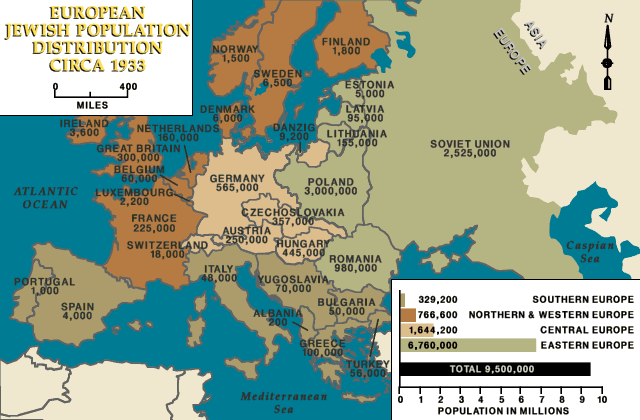
It was a systematic, bureaucratic, state-sponsored persecution and murder of approximately six million Jews by the Nazi regime and its collaborators.
Many different groups were targeted as well, even though the Jews were the main ones. This was because Nazis saw all the the other groups as "racially inferior". Within those groups where the Roma (Gypsies), the disabled, and some of the Slavic peoples (Poles, Russians, and others). Other groups were persecuted on political, ideological, and behavioral grounds such as the Communists, Socialists, Jehovah's Witnesses, and homosexuals.
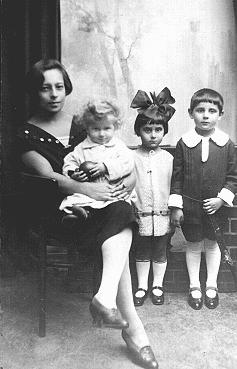
Prewar photograph of three Jewish children with their babysitter. Two of the children perished in 1942. Warsaw, Poland, 1925-1926.
— United States Holocaust Memorial Museum
By 1945, the Germans and their collaborators killed nearly two out of every three European Jews as part of the "Final Solution". The final solution was the Nazi policy to murder the Jews of Europe.
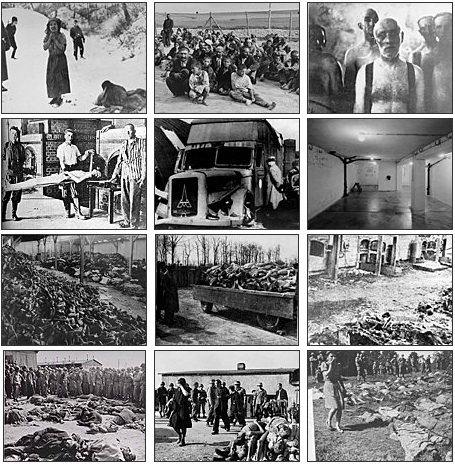
Administration of the "FINAL SOLUTION" was done by constructing concentration camps and guettos. Guettos were used to monitor the Jewish population as well as to facilitate later deportation They were cramped and unsanitary. . It was common for the Jews to be exploited and made to work until they expired in the concentration camps.Concentration camps were also used as killing grounds. Jews were either thrown in gas chambers, shot, or experimented on and later cremated. Upon arriving at these camps, many Jews did not know what was about to hit them. Those capable of working were separated upon arrival from children and those uncapable of working, who were killed right away. Many jews died in these concentration camps.

Discussion questions: The U.S. and Great Britain claim that they did not know to the extent of what was going on in the concentration camps until it was to late. What do you think about this? Do you think that they would have been capable to stop it sooner? What are your reactions upon seeing these pictures?
Very few Jews were able to survive and to do so, they had to change their identities. What do you think of this? Hiding in fear, pretending to be someone who you are not just to survive although other people were not as lucky...
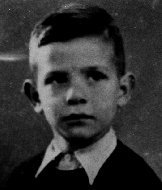
May 3, 1934Jan-Peter's father, Heinz, was a German-Jewish refugee who married Henriette De Leeuw, a Dutch-Jewish woman. Frightened by the Nazi dictatorship and the murder of Heinz's uncle in a concentration camp, they emigrated to the Netherlands when Henriette was nine months pregnant. They settled in Amsterdam.
1933-39: Jan-Peter was born soon after his parents arrived in the Netherlands. He was 18 months old when Tommy, his baby brother, was born. In 1939 the parents and brother of Jan-Peter's father joined them in the Netherlands as refugees from Germany. Jan-Peter and Tommy grew up speaking Dutch as their native language, and they often spent time at their mother's family home in the country.
1940-44: The Germans occupied Amsterdam in May 1940. Despite the German occupation, 6-year-old Jan-Peter did not feel much change in his day-to-day life. Then just after his ninth birthday, the Germans sent his grandmother to a camp called Westerbork. Six months later, Jan-Peter and his family were sent to the same camp, but his grandmother was no longer there. During the winter, the Pfeffers were sent to a faraway ghetto called Theresienstadt where Jan-Peter felt cold, scared, and hungry.
On May 18, 1944, Jan-Peter was deported with his family to Auschwitz. He was gassed on July 11, 1944. Jan-Peter was 10 years old.


Some videos:
http://www.youtube.com/watch?v=xVkc-0cI91o
http://www.youhttp//www.youtube.com/watch?v=a6jnawYwm3E&feature=relatedtube.com/watch?v=piJYvWmMgT4&feature=fvwrel
As the second video shows, not alot of people really know much about the holocaust. But to say that it never happened would be like to say that we are not really here...
Controversity
There are people out there who still question whether or not the holocaust really happened. After reading these real stories, seeing these photgraphs, and watching these videos, what do YOU think?| Gitla Zoberman Born 1917 Sandomierz, Poland  |  | "Gitla was the second-youngest of four girls born to observant Jewish parents. They made their home in Sandomierz, a predominantly Catholic town on the Vistula River. Her father owned a small bookstore across from the town hall, selling school texts and novels. Gitla attended public school before enrolling in a Catholic girls' high school. In the winter, Gitla enjoyed skating on the Vistula. 1933-39: In 1937 I moved to Katowice, a large town on the Polish-German border. There, I enrolled in a business college and lived with my sister, Hana, who worked as a pharmacist. In August 1939 we heard that the Germans would invade Poland. Hana and I decided to return to Sandomierz, where we thought we would be safer. On September 1, 1939, the Germans invaded Poland. They occupied Sandomierz two weeks later. 1940-44: After one year in the Pionki labor camp, my father and I escaped to Warsaw. My sister Irene, whose Aryan features and good Polish let her pass as a Christian, arranged our way to the city, aided by a Polish man she'd hired. In Warsaw, I stayed locked in Irene's apartment while she worked. After we dyed my dark hair blonde, I got a job as a dishwasher. I had false ID and wore a cross. My disguise failed. A boy on the streetcar pointed at me and yelled "Kike," an insult for Jews. I never left the apartment again. Gitla was deported to Stutthof and Gross-Rosen camps, before being liberated by Soviet forces in January 1945. Her sisters, mother and father all survived. " | ||
Very few Jews were able to survive and to do so, they had to change their identities. What do you think of this? Hiding in fear, pretending to be someone who you are not just to survive although other people were not as lucky...
Jan-Peter Pfeffer
Born: Amsterdam, NetherlandsMay 3, 1934
1933-39: Jan-Peter was born soon after his parents arrived in the Netherlands. He was 18 months old when Tommy, his baby brother, was born. In 1939 the parents and brother of Jan-Peter's father joined them in the Netherlands as refugees from Germany. Jan-Peter and Tommy grew up speaking Dutch as their native language, and they often spent time at their mother's family home in the country.
1940-44: The Germans occupied Amsterdam in May 1940. Despite the German occupation, 6-year-old Jan-Peter did not feel much change in his day-to-day life. Then just after his ninth birthday, the Germans sent his grandmother to a camp called Westerbork. Six months later, Jan-Peter and his family were sent to the same camp, but his grandmother was no longer there. During the winter, the Pfeffers were sent to a faraway ghetto called Theresienstadt where Jan-Peter felt cold, scared, and hungry.
On May 18, 1944, Jan-Peter was deported with his family to Auschwitz. He was gassed on July 11, 1944. Jan-Peter was 10 years old.
Some videos:
http://www.youtube.com/watch?v=xVkc-0cI91o
http://www.youhttp//www.youtube.com/watch?v=a6jnawYwm3E&feature=relatedtube.com/watch?v=piJYvWmMgT4&feature=fvwrel
As the second video shows, not alot of people really know much about the holocaust. But to say that it never happened would be like to say that we are not really here...
